
Problem
Furnace won't turn on or won't light?
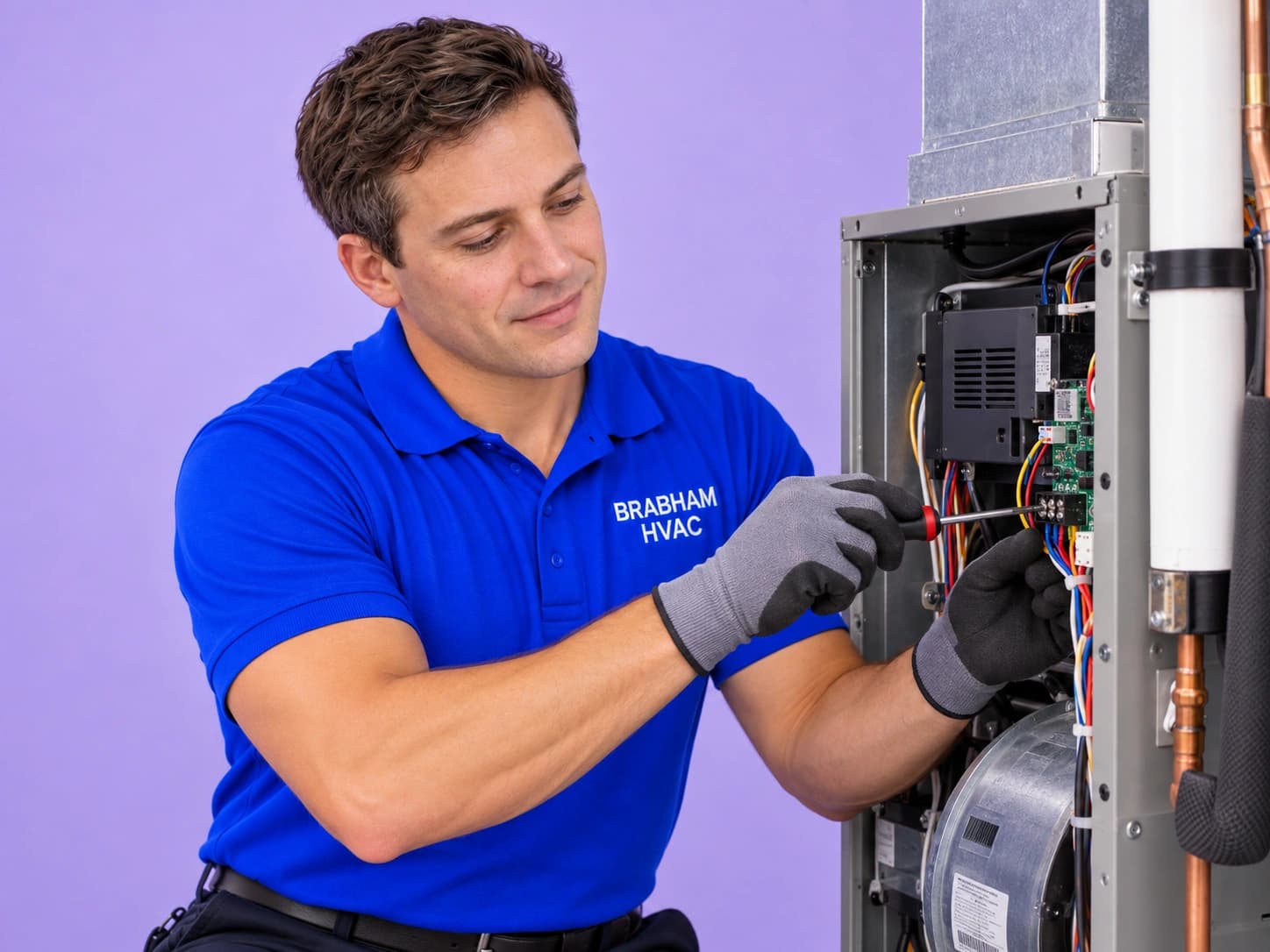
A gas furnace that won't light is most often a worn igniter, a dirty flame sensor, a clogged filter tripping a safety limit, or a thermostat or power problem. A furnace that lights and then shuts off within seconds is the classic flame-sensor pattern. Check the thermostat, filter and breaker. Anything involving the gas valve or burners needs a technician.
If you smell gas, leave the house now and call your gas utility or 911 from outside. For no heat on a cold night, call — emergency service runs 24/7.
What usually causes this
These are the common possibilities, not a diagnosis. A page cannot tell which one it is — that takes a technician testing the system.
- Igniter worn out
- Hot surface igniters weaken every time they heat and eventually crack. The furnace tries to start but never lights.
- Dirty flame sensor
- The furnace lights, can't confirm the flame, and shuts the gas off within seconds for safety — then often tries again.
- Safety limit tripped
- A clogged filter or blocked return lets the furnace overheat, and the limit switch shuts the burners off. The switch is doing its job; the airflow is the problem.
- Thermostat, power or door switch
- Dead thermostat batteries, a tripped breaker, the furnace power switch turned off, or a loose front panel can all stop a start.
- Draft inducer or pressure switch
- Before lighting, the furnace proves its venting is clear. A failed inducer motor, a blocked vent or a faulty pressure switch stops the sequence.
- Gas supply
- A closed gas valve or a supply problem. Other gas appliances not working is a clue.
What you can safely check yourself
- Set the thermostat to Heat, a few degrees above room temperature. Replace batteries if it uses them.
- Check the furnace's power switch (it looks like a light switch near the unit) and its breaker.
- Replace the filter if it's dirty.
- Make sure the furnace's front panel is fully in place — a loose panel keeps it off.
- Check that other gas appliances, such as a water heater or stove, are working.
Leave these alone
- · Manually lighting the burners or holding a flame near them.
- · The gas valve, burners, igniter and flame sensor.
- · Repeatedly cycling the power to force restarts — if it keeps failing, it's telling you something.
Call rather than book online if:
- · You smell gas — leave first, then call the gas utility or 911 from outside
- · A carbon monoxide alarm sounds — get everyone outside and call 911
- · You see soot around the furnace, or the flame is yellow and lazy instead of blue
What we check when we get there
- 1The technician watches the ignition sequence to see exactly where it fails — inducer, pressure switch, igniter, flame proving or limit.
- 2The heat exchanger and venting are inspected as a safety matter on any gas heating call.
- 3If airflow tripped a limit, the filter, blower and returns are checked, because replacing the switch alone just removes the protection.
What it is likely to cost
Flame sensors and igniters are common, moderate repairs. Inducer motors, gas valves and control boards cost more. A cracked heat exchanger is quoted individually and often leads to a replacement conversation.
- Heating diagnostic
- $89
- Flame sensor
- From $149
- Ignitor
- From $199
- Pressure switch
- From $199
- Inducer motor
- From $549
- Gas valve
- From $349
- Control board
- From $449
Prices are starting points for standard work in the Savannah area. Final price depends on the system and site, and is confirmed before work begins. Permits and code-required upgrades may be additional.
Repair or replace?
Igniters and flame sensors are ordinary wear repairs on a furnace of almost any age. A cracked heat exchanger, or repairs piling up on a furnace over about 15–20 years old, is when replacement is worth comparing.
Compare repair vs replacementQuestions people ask about this
- Why does my furnace light and then shut off?
- The most common reason is a dirty flame sensor: the burners light, the furnace can't confirm the flame, and it shuts the gas off within seconds. It needs cleaning or replacement by a technician.
- My furnace hasn't run since last winter. Should I test it?
- Yes. Run the heat for a few minutes on a mild fall day. Finding a problem then is far better than finding it on the first cold night.
- There's a burning smell when the heat first comes on.
- A short burning-dust smell on the first run of the season is normal. A smell that persists, or smells electrical, is not — switch off and call.
Where to go next
The service that fixes this
Heating & Furnace Repair
Furnace not lighting, blowing cold, or cutting out early? We get heat back and check it is safe.
HeatingWork out the decision
Get it looked at
We cover Savannah, the Coastal Empire and the South Carolina Lowcountry. Tell us what the system is doing — you do not need to know the cause. The diagnostic price is given to you before the visit, and the repair price before any work starts.